
Wyoming WYDOT Motorcycle Practice Test 1
- Questions25
- Correct to pass20
- Passing score80%
- Minimum age15 years
-
1. You come around a bend and find loose sand spread across your lane. What should you do?
Show answer
Answer D: Ease off the gas, avoid sudden braking or steering, and keep straight
Loose material acts like ball bearings under the tires; smooth inputs preserve what little grip remains, while sudden braking or steering breaks it.
-
2. Two left-turn lanes are available and you must turn right again a short distance after the turn. Which of the two should you use?
Show answer
Answer D: The right one, so you finish nearer the right side of the new street
Each turn lane feeds the matching lane of the new street, so choosing the right-hand of the two left-turn lanes leaves you closer to the side you will need.
-
3. A person using a wheelchair is waiting to cross at a corner ahead. How should you treat that person?
Show answer
Answer B: As a pedestrian with the right of way at the crossing
A wheelchair or a mobility scooter user has the rights of a pedestrian, so yield the whole crossing and wait until the crossing is finished.
-
4. An oncoming car is waiting to turn left across your path at an intersection. What is the safest response?
Show answer
Answer D: Slow, cover the brakes and pick a lane position that keeps an escape path
A car turning left in front of a rider is one of the most common motorcycle collisions, so the rider prepares to stop or swerve rather than trusting the driver to wait.
-
5. Two solid yellow lines are painted down the center of a two-way road. What do they mean?
Show answer
Answer B: Traffic in neither direction may cross them to pass
A double solid yellow line marks a no-passing zone that applies to traffic traveling in either direction.
-
6. A crossing guard steps into the roadway ahead of this sign with one hand raised. What must the driver do?

Show answer
Answer B: Stop and stay stopped until the guard waves traffic on
An adult guard is controlling traffic at that crossing, so the instruction given by that person governs and the driver waits to be released.
-
7. The only person offering you a ride home has been drinking. What should you do?
Show answer
Answer B: Do not get in; find another way home
A passenger in an impaired driver's vehicle shares all of the risk and can do nothing about it from the seat, so the only safe answer is another ride.
-
8. Which ability does alcohol usually affect first?
Show answer
Answer A: Judgment and self control
Alcohol reduces judgment and inhibition before a drinker notices any clumsiness, which is why an impaired driver often feels perfectly capable while already driving worse.
-
9. At many crossings the walk indication appears only after a button is pressed. What happens if a pedestrian does not press it?
Show answer
Answer B: The signal may cycle without showing a walk indication
An actuated pedestrian phase is called in by the pushbutton, so without it the controller may serve the vehicle movements alone.
-
10. Driving at night you notice that the raised markers along the line beside you are throwing back red light. What does that tell you?
Show answer
Answer C: You are facing traffic and must get off that roadway
Red retroreflection is shown only toward traffic that should not be there, so a red return means the vehicle is heading the wrong way.
-
11. You are very angry after an argument and about to drive. What should you know?
Show answer
Answer A: Strong emotions can impair judgment and attention much like alcohol
Anger, grief and stress pull attention inward and encourage risk taking. Give yourself time to settle down before getting behind the wheel.
-
12. A row of solid white triangles points toward you across your lane. What does it mark?
Show answer
Answer A: The place to yield to traffic or people ahead
A yield line of triangles shows drivers exactly where to give way, and it is used at roundabouts and at midblock crosswalks.
-
13. What does a flashing yellow traffic light mean?
Show answer
Answer B: Slow down and proceed with caution
A flashing yellow lets you enter the intersection cautiously after yielding to pedestrians and to conflicting traffic that is already there.
-
14. Besides school signing, which warning signs may also use a fluorescent yellow-green background?
Show answer
Answer C: Pedestrian and bicycle warning signs
Pedestrian crossing, bicycle and playground warning signs may use either the standard yellow or the fluorescent yellow-green background, which draws extra attention where people outside vehicles are present.
-
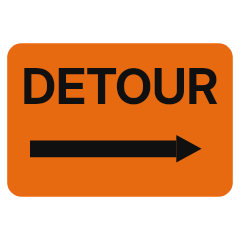
15. Which of these is true of the roadway a driver is being sent onto here?
Show answer
Answer D: Its own signs, signals and speed limits govern for the whole way around
The alternate route is an ordinary public road, so every control posted on it governs as usual; being sent that way grants no extra priority and no relief from the limits in force there.
-
16. A set of reversible express lanes is closed off with gates and signs while it runs the other way. What must you never do?
Show answer
Answer C: Enter past a closed gate or a sign showing the lanes are closed
When reversible lanes are closed they may already be carrying traffic in the opposite direction, so entering past a gate can put you head-on into that traffic.
-
17. Why is smooth, early braking better than hard, late braking?
Show answer
Answer D: It keeps you in control and gives the driver behind more warning
Braking early and gently keeps the tires well within their grip and gives following drivers time to react to your brake lights.
-
18. Your green left-turn arrow goes out and a steady green ball stays lit. What may you do?
Show answer
Answer A: Continue turning left, but only after yielding to oncoming traffic
When the arrow ends and a green ball remains, the turn changes from protected to permissive, so it is still allowed but oncoming traffic goes first.
-
19. You need to leave the road and pull onto the shoulder. What should you check first?
Show answer
Answer A: Whether the shoulder surface is firm enough to support the motorcycle
Soft or loose shoulder material can grab the wheels or let the side stand sink, so confirm the surface is firm, signal, and then pull well clear of traffic.
-
20. The rider who was behind you has vanished from your mirrors. What should you do?
Show answer
Answer C: Ease off and pass the word forward so the group can respond
A rider missing from the line may have stopped or had trouble, and the group needs to know at once so it can slow down or pull over safely.
-
21. A school sign combined with an AHEAD plaque, or with a plaque giving a distance in feet, forms an assembly that
Show answer
Answer B: warns of a school crossing located further along the road
The school advance crossing assembly is placed before the crosswalk to give drivers notice, while a different assembly marks the crossing itself.
-
22. A rectangular marker with alternating black and retroreflective yellow stripes set at a slant is used to
Show answer
Answer C: mark an obstruction, with the stripes sloping down toward the side on which traffic should pass
This striped panel is an object marker, and the direction in which the stripes slope shows the driver which side of the obstruction to pass on.
-
23. How long should a head check before a lane change last?
Show answer
Answer D: A quick glance, so you do not lose track of what is happening ahead
Traffic ahead can change in a second, so the blind spot check is a fast glance and the rider returns attention to the road immediately.
-
24. When should a staggered group change to single file?
Show answer
Answer C: In curves, in turns, and when entering or leaving a highway
Curves, turns and highway entrances and exits require the full width of the lane, so the group rides single file at those points.
-
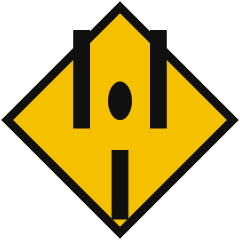
25. What change in the road does this sign announce?
Show answer
Answer B: The two directions of travel are about to be separated, and the driver must keep to the right of the separation
Ahead the roadway splits into separate one-way roadways on either side of a median, so the driver stays to the right of the divider and no longer meets oncoming vehicles.