
Wyoming WYDOT Motorcycle Practice Test 11
- Questions25
- Correct to pass20
- Passing score80%
- Minimum age15 years
-
1. A vehicle in front of you has already begun turning left into a driveway when the gap you were waiting for opens up. What should you do?
Show answer
Answer B: Wait and let that driver finish the turn
A vehicle that has lawfully started a maneuver keeps the right of way until it is finished.
-
2. When is it safe to return to your own lane after passing a vehicle?
Show answer
Answer C: Once you can see the whole front of that vehicle in your mirror
Seeing the entire front of the vehicle in the mirror proves there is a full vehicle length of clear road, which the rider cannot judge by feel alone.
-
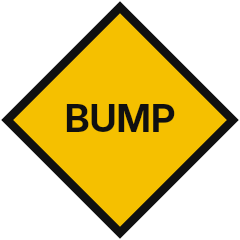
3. Why does this warning matter more on a motorcycle than in a car?
Show answer
Answer B: Because a sudden jolt can unsettle a two-wheeled machine and the rider can lose control
A jolt can push a motorcycle off line or lift a wheel, so a rider slows early, comes slightly off the seat and keeps a relaxed but firm hold on the handlebars.
-
4. Which items belong to the Controls step of the T-CLOCS inspection?
Show answer
Answer D: Handlebars, levers, cables, hoses and the throttle
The Controls step covers everything the rider operates by hand or foot, plus the cables and hoses that carry those inputs to the machine.
-
5. You arrive at an intersection where the traffic signal is completely dark because of a power failure. How should you proceed?
Show answer
Answer C: Treat the intersection as an all-way stop
When a signal shows no indication at all, drivers on every approach must stop and then take turns, exactly as at an all-way stop.
-
6. What happens to a motorcycle's ground clearance when a passenger is carried?
Show answer
Answer A: It is reduced, so parts touch down at a smaller lean angle
The extra load compresses the suspension and lowers the machine, so footrests and other parts can drag on the road sooner in a turn.
-
7. Your low beams light about 250 feet of road, but at your speed you would need more than that to stop. What is that called?
Show answer
Answer D: Overdriving your headlights
When your stopping distance is longer than the stretch of road your headlights show, you cannot react to anything you finally see. Slow down until you can.
-
8. A traffic signal is displaying a flashing red light. How must you treat it?
Show answer
Answer D: Stop completely, then proceed when the way is clear
A flashing red carries the same meaning as a stop sign: come to a full stop, then go only when it is safe.
-
9. You are turning left into a street that is divided by a raised median. Which side should you enter?
Show answer
Answer C: The right-hand roadway, so that you travel on the proper side
A raised median separates two directions of travel, so the turn must be completed into the roadway carrying traffic your way.
-
10. Cannabis is legal for adults in some states. What does that mean for driving?
Show answer
Answer C: Driving while impaired by it is still an offense
Legal possession has nothing to do with driving law, and every state treats driving while impaired by cannabis as an offense.
-
11. You are on an entrance ramp merging onto a freeway. Who has to give way?
Show answer
Answer B: You must yield and fit into a gap in the traffic already on the freeway
Traffic entering a highway must yield to traffic already on it. Use the acceleration lane to match speed and merge into a gap.
-
12. What should riders expect from highway traffic when a group is merging?
Show answer
Answer C: Drivers will not hold a gap open for the group, so riders take real gaps
Other drivers do not treat a line of motorcycles as one vehicle, so each rider has to find a genuine gap rather than count on being let in.
-
13. The sun is low behind you and shining into the eyes of oncoming drivers. What should you do?
Show answer
Answer C: Turn on your headlights and expect oncoming drivers not to see you
Drivers facing the low sun may not see you at all, so make yourself as visible as possible and give way rather than insisting on your right of way.
-
14. What protective gear should a passenger wear?
Show answer
Answer C: The same protective gear recommended for the operator
A passenger is exposed to the same crash forces, weather and road debris as the operator, so the same head, eye, hand, body and foot protection applies.
-
15. You are riding in the right hand lane of a freeway and vehicles ahead are merging on from an entrance ramp. What is the best response?
Show answer
Answer C: Change lanes if you safely can, or adjust speed to open a gap for them
Merging drivers are looking over a shoulder for a gap and easily miss a motorcycle, so the rider makes room rather than waiting to be seen.
-
16. The drive chain breaks or comes off while you are riding. What should you do first?
Show answer
Answer A: Close the throttle and brake to a stop clear of the roadway
A broken chain or belt takes the drive away at once, so the rider closes the throttle, slows under control with both brakes and stops well off the roadway.
-
17. Under Wyoming's youthful-driver alcohol law, does the maximum fine increase between a first conviction and a third conviction within two years?
Show answer
Answer C: No, the maximum fine stays capped at 750 dollars at every tier; only the potential jail term increases
Wyoming statute caps the fine for a youthful-driver alcohol conviction at 750 dollars at every tier; what changes between a first and a later conviction is the potential jail term, not the fine ceiling.
-
18. In a work zone the temporary lane lines conflict with the old lines still visible on the pavement. Which do you follow?
Show answer
Answer C: The temporary markings, which show the current traffic pattern
Temporary markings define the traffic pattern in force, and the old lines are simply the layout that no longer applies.
-
19. When downshifting as the motorcycle slows, what keeps the rear tire from skidding?
Show answer
Answer A: Easing the clutch lever out smoothly instead of releasing it abruptly
Letting the clutch out gradually lets engine speed and road speed match, so the rear wheel is not forced to slow suddenly.
-
20. You are stopped in a line of traffic waiting at a red light. What is the safest way to wait?
Show answer
Answer A: Stay in first gear, keep watching the mirrors and leave a way out
A vehicle approaching from behind may not stop in time, and staying in gear with a gap ahead lets the rider move out of the way.
-
21. You are about to pass another vehicle at night with your high beams on. What should you do?
Show answer
Answer C: Switch to low beams as you come up behind it and while you are alongside
High beams shining into the mirrors of the vehicle ahead blind the very driver whose reaction you depend on during the pass.
-
22. On a highway with mileage-based exit numbering, you have just passed exit 42 and are looking for exit 55. About how far is it?
Show answer
Answer B: Thirteen miles
With mileage-based numbering each exit takes the number of the nearest milepost, so subtracting one exit number from another gives the distance in miles.
-
23. A flagger turns the paddle to the orange face reading SLOW. What does that tell approaching drivers?
Show answer
Answer D: Reduce speed and continue through the work area with care
The SLOW face keeps traffic moving at a reduced speed while workers or equipment are close to the travel lanes.
-
24. How long should a glance at a mirror or an instrument take?
Show answer
Answer A: A brief glance of about a second, returning your eyes to the road at once
Checks should be quick flicks of the eyes. At highway speed, a few seconds with your eyes off the road covers a distance long enough for a hazard to appear.
-
25. What should a group agree on before the ride begins?
Show answer
Answer A: The route, the fuel and rest stops, and the hand signals to be used
Settling the route, the stops and the signals before departure keeps the group together and avoids sudden, confusing decisions once it is moving.