
Wyoming WYDOT Permit Practice Test 17
- Questions25
- Correct to pass20
- Passing score80%
- Minimum age15 years
-
1. Why is texting considered one of the most dangerous distractions?
Show answer
Answer B: It combines visual, manual and cognitive distraction at the same time
Reading or writing a message takes your eyes off the road, at least one hand off the controls and your attention off driving simultaneously.
-
2. Warning signs such as stop ahead, yield ahead and signal ahead are installed mainly where
Show answer
Answer B: the traffic control device cannot be seen from far enough away
These advance warning signs are used when a crest, curve or obstruction keeps the stop sign, yield sign or signal from coming into view in time for a driver to react.
-
3. On a school speed limit sign, the part carrying the word SCHOOL is shown
Show answer
Answer A: in black on a fluorescent yellow-green background
The SCHOOL portion of the school speed limit sign uses the same fluorescent yellow-green background as school warning signs, while the speed portion keeps the standard regulatory appearance.
-
4. A notification appears on your smart watch while you are driving. What should you do?
Show answer
Answer B: Treat it as you would a phone and leave it
A watch screen demands the same eyes and the same attention as a phone, and a wrist is no safer a place to read a message than a dashboard.
-
5. Under Wyoming's driver license classification system, what may the holder of a Class C license legally operate?
Show answer
Answer A: Any single vehicle or combination of vehicles that does not require a commercial driver license, other than a motorcycle
WYDOT's license classification guide defines Class C as the general license covering any vehicle or combination that does not require a commercial driver license, other than a motorcycle.
-
6. Why does this warning matter more on a motorcycle than in a car?
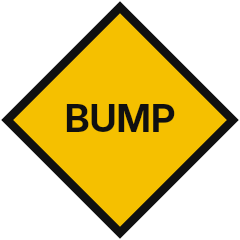
Show answer
Answer B: Because a sudden jolt can unsettle a two-wheeled machine and the rider can lose control
A jolt can push a motorcycle off line or lift a wheel, so a rider slows early, comes slightly off the seat and keeps a relaxed but firm hold on the handlebars.
-
7. A motorcycle ahead of you is weaving slightly as it crosses a stretch of grooved pavement. What should you do?
Show answer
Answer D: Give the rider extra room until the surface improves
Grooves, metal plates and loose material affect a motorcycle far more than a car, so back off and let the rider deal with the surface.
-
8. You are turning left from a two-way street onto a one-way street. Which lane should you enter?
Show answer
Answer C: The first lane open to traffic on the left side of the one-way street
Turn left from the lane closest to the center line and finish in the first available lane on the left of the one-way street, then change lanes if you need to.
-
9. A driver passes this sign on an open road. Over what stretch does the figure it sets stay in force?
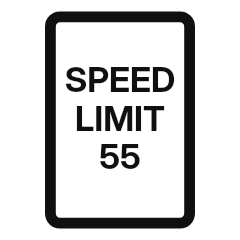
Show answer
Answer A: From the sign onward, in every lane, until another sign sets a different figure
The figure governs the road from the sign onward and binds every lane, and it stays in force until a later sign sets a different one.
-
10. A yellow diamond shows two lanes narrowing into one. What does it require of a driver?
Show answer
Answer D: Adjusting speed and merging before the lane disappears
The lane ends sign gives notice that one lane will be dropped, so drivers should adjust speed and blend into the continuing lane in good time.
-
11. Beyond the point this sign refers to, which movement becomes unlawful?
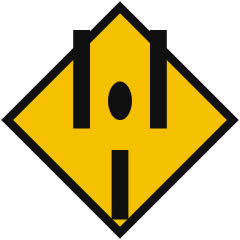
Show answer
Answer D: Driving on the far side of the separation, against the flow
Once the two directions are separated, each roadway carries one-way traffic, so crossing to the other side means driving into oncoming vehicles.
-
12. You turn from asphalt onto a loose gravel road. What should you do about your speed?
Show answer
Answer D: Lower it, since grip is reduced and stopping takes longer
Loose gravel gives far less grip than pavement, so speed must come down for both steering and stopping.
-
13. Traffic safety experts describe three kinds of driver distraction. Which set is correct?
Show answer
Answer A: Visual, manual and cognitive
Distraction takes the eyes off the road, the hands off the controls or the mind off driving, and many activities do more than one of those at once.
-
14. Driving at night you notice that the raised markers along the line beside you are throwing back red light. What does that tell you?
Show answer
Answer C: You are facing traffic and must get off that roadway
Red retroreflection is shown only toward traffic that should not be there, so a red return means the vehicle is heading the wrong way.
-
15. Two vehicles reach a four-way stop at the same moment from adjacent roads. Who should go first?
Show answer
Answer A: The driver on the right
When two drivers stop at a four-way stop at the same time, the driver on the left yields to the driver on the right.
-
16. You are following a tractor-trailer so closely that its rear doors fill your windshield. What is the main problem?
Show answer
Answer D: You cannot see the road ahead and the truck driver cannot see you
A truck has a deep blind spot directly behind it, and tailgating also hides everything in front of the truck from you. Drop back so you can see and be seen.
-
17. What does a sign showing a bicycle inside a red circle with a diagonal slash prohibit?
Show answer
Answer D: Riding a bicycle on that roadway
This is a selective exclusion sign, used where bicycles are banned from a road such as a freeway or a tunnel.
-
18. When should most of your braking for a turn be finished?
Show answer
Answer B: Before you begin to turn the wheel
Slow to the right speed before the turn begins; braking hard while turning uses up the grip the tires need for steering.
-
19. You have a small extinguisher and a fire has started under the hood. What is the safe way to use it?
Show answer
Answer B: Release the latch and spray through the gap without raising the hood at all
Opening the hood feeds the fire a rush of air, so spraying through the gap at the base of the flames is both safer and more effective.
-
20. You must cross a stretch of water lying across the road that you know is shallow. What is the right technique?
Show answer
Answer A: Slow down before you reach it and cross steadily in a low gear
Slow before the water, then keep a steady low speed so you do not throw water over the engine or lose steering. Test the brakes gently once you are through.
-
21. How can you check that you are keeping a safe following distance?
Show answer
Answer A: Count at least three seconds between the vehicle ahead passing a fixed object and your reaching it
Pick a fixed roadside object, start counting when the vehicle ahead passes it and make sure at least three seconds elapse before you reach it, adding more time in poor conditions.
-
22. You want to turn left at an intersection with no signs or signals and a vehicle is coming straight toward you from the opposite direction. What must you do?
Show answer
Answer C: Yield and turn after the oncoming vehicle has passed
A driver turning left always gives way to oncoming traffic that is close enough to be a hazard, whether or not the intersection is controlled.
-
23. On a multi-lane street, a yield line is painted well back from an unsignalized crosswalk rather than right at it. Why?
Show answer
Answer D: So drivers in the other lanes can see the pedestrian
Setting the yield line back keeps a stopped vehicle from hiding a crossing pedestrian from drivers in the next lane, which is a common cause of these crashes.
-
24. A car is coming straight at you in your lane and there is no time for it to move back. What should you do?
Show answer
Answer A: Brake, sound the horn and steer to the right, toward the shoulder or ditch
Steering right takes you away from the other vehicle even if its driver corrects course, and the shoulder or ditch is survivable.
-
25. Every signal head at an intersection is flashing red in all directions. How should you treat the intersection?
Show answer
Answer C: As an all-way stop, stopping and then going in turn
Red flashing in every direction means each approach must stop, so the intersection works exactly like an all-way stop.