
Wyoming WYDOT Permit Practice Test 9
- Questions25
- Correct to pass20
- Passing score80%
- Minimum age15 years
-
1. Does using a hands free device remove the risk of distraction?
Show answer
Answer A: No, the conversation still takes attention away from driving
Hands free equipment removes the manual part of the distraction but not the mental part, and a driver deep in conversation can look straight at a hazard without registering it.
-
2. At what minimum age may a Wyoming resident first apply for a driver instruction permit?
Show answer
Answer B: 15 years
Wyoming sets 15 as the minimum age for an ordinary driver instruction permit, the first stage of its licensing ladder for a new driver.
-
3. An overhead lane-use control signal shows a steady red X above your lane. What does it mean?
Show answer
Answer B: You may not use that lane and must move out of it
A steady red X means the lane below it is closed to you, while a steady yellow X is the warning to prepare to vacate the lane and a downward green arrow means the lane is open.
-
4. You notice that the driver ahead of you is holding a phone to the ear. What should you do?
Show answer
Answer C: Assume slower reactions and leave extra space, or else hold back
A driver on the phone reacts late and misses things, so the safe response is distance rather than a lesson.
-
5. What extra service charge does WYDOT add for a driver whose license carries an ignition interlock restriction?
Show answer
Answer C: A 100 dollar interlock service charge
WYDOT's published fee schedule lists a 100 dollar interlock service charge that applies to a driver whose license carries an ignition interlock restriction.
-
6. A yellow sign ahead of an underpass reads LOW CLEARANCE 12 FT 6 IN. What does the figure tell you?
Show answer
Answer B: The greatest height that can pass beneath the structure
The figure is the actual clearance available, so a vehicle taller than that must leave the road and take a marked alternative route.
-
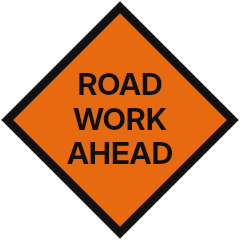
7. Beyond this sign, cones and temporary signs lead traffic along a path that does not agree with the lines painted on the pavement. Which one must the driver follow?
Show answer
Answer C: The temporary arrangement, because it replaces the permanent layout while the work lasts
Temporary traffic control set up for the work takes precedence over the permanent signs and markings, which no longer describe how the road is being used.
-
8. A steady green downward arrow is displayed above the lane you are in. What does it tell you?
Show answer
Answer A: You may drive in that lane
A green downward arrow means the lane beneath it is open for travel in your direction.
-
9. Why should you avoid parking over tall dry grass or a pile of dead leaves?
Show answer
Answer B: Because the hot exhaust can set the dry material on fire
The exhaust system stays hot for a long time after a drive and can ignite dry vegetation underneath the vehicle.
-
10. You have finished a distracting task and your eyes are back on the road. What is true?
Show answer
Answer A: Your full attention takes a while to come back
Studies of drivers show attention lags behind the eyes for many seconds after a phone or a screen task, so the danger continues after the task is over.
-
11. How should a turn at an intersection be taken on a wet road?
Show answer
Answer C: Slow earlier than usual and steer smoothly through the corner
Wet pavement leaves less grip, so the speed must come off before the turn and the steering must be gentle enough not to break traction.
-
12. You are turning left into a street that is divided by a raised median. Which side should you enter?
Show answer
Answer C: The right-hand roadway, so that you travel on the proper side
A raised median separates two directions of travel, so the turn must be completed into the roadway carrying traffic your way.
-
13. The posted limit is 55 mph, but heavy traffic and rain make that speed unsafe. What does the law expect of you?
Show answer
Answer D: You must slow to a speed that is safe for the conditions
The basic speed rule requires a speed that is reasonable for the traffic, weather and road, and that speed is often well below the posted maximum.
-
14. You are following another vehicle down a long, steep grade. What should you do about the gap?
Show answer
Answer D: Make it longer, because both of you need more room to stop
Everything takes longer to stop on a downgrade, including the vehicle ahead, so the gap that works on the flat is no longer enough.
-
15. A broken white line separates your lane from the lane beside it. What does it indicate?
Show answer
Answer C: Both lanes carry traffic in the same direction and lane changes are permitted
White lines separate lanes of traffic moving in the same direction, and a broken white line means changing lanes across it is permitted when it is safe.
-
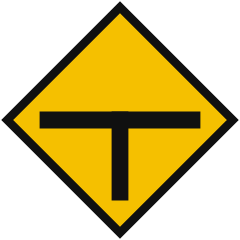
16. What must a driver be prepared to do at the point this sign refers to?
Show answer
Answer D: Turn left or right, because the road being traveled ends there
The road ends at another roadway, so the driver must slow, give way to traffic on the through road and turn in one direction or the other.
-
17. A friend who has been drinking insists on driving home. What is the right thing to do?
Show answer
Answer B: Take the keys and arrange a sober ride, even if the friend objects
An impaired driver is dangerous on any street at any speed, and coffee does not lower blood alcohol. Keeping the keys and finding another way home is the only safe choice.
-
18. You turn the wheel but the front of the vehicle keeps sliding straight ahead on a slippery road. What should you do?
Show answer
Answer C: Ease off the accelerator and reduce the steering angle until the front tires grip again
A front-wheel skid means the tires are asking for more grip than the surface can give. Less speed and less steering angle let them regain traction.
-
19. A pedestrian steps off the curb without looking your way. What should you assume?
Show answer
Answer B: That the person has not seen you at all, and be ready to stop for them
Defensive driving means assuming you have not been seen until there is clear evidence that you have.
-
20. You realize you have turned the wrong way onto a one-way street. What should you do?
Show answer
Answer A: Pull to the right, stop, and back into the street you came from when clear
Get out of the traffic stream first: pull right and stop, then back out into the street you came from once you can see it is safe.
-
21. Why can a motorcycle ahead of you slow down without any warning light showing?
Show answer
Answer B: The rider may slow by downshifting or rolling off
Riders often lose speed by closing the throttle or changing down, which does not switch on the brake light, so watch the machine itself and keep back.
-
22. The vehicle in front of you has stopped and is waiting to turn left, and there is a paved shoulder to the right. May you use it to get by?
Show answer
Answer D: No, in most states a pass may not be made by leaving the paved travel lanes
Passing on the right is normally lawful only inside the marked travel lanes, and most states prohibit driving onto the shoulder to get around a turning vehicle; the few states that allow it attach strict conditions.
-
23. Does Wyoming's statewide open container law apply inside a city that has adopted its own local ordinance on the subject?
Show answer
Answer D: No, the state section does not apply within a municipality that has adopted its own open-container ordinance
Wyoming statute exempts a driver from the state open-container section within any incorporated municipality that has adopted its own ordinance prohibiting open containers.
-
24. A sign with a yellow background and a black legend generally conveys
Show answer
Answer B: a general warning
Yellow is the background color used for general warning signs, so a yellow sign tells the driver to expect something ahead rather than to obey a rule.
-
25. Small green signs with white numerals posted at regular intervals along a highway are used to
Show answer
Answer B: show distance along the route and give a reference point for reporting a location
Reference location signs, commonly called mileposts, carry white numerals on green and let a driver describe exactly where a breakdown or crash has occurred.