
Wyoming WYDOT Motorcycle Practice Test 49
- Questions25
- Correct to pass20
- Passing score80%
- Minimum age15 years
-
1. Which warning sign keeps its yellow background even when it is used inside a work zone?
Show answer
Answer D: The grade crossing advance warning sign
The round grade crossing advance warning sign keeps its black legend on yellow inside temporary traffic control zones because the railroad hazard it describes is not temporary.
-
2. What is the purpose of the engine cut-off switch?
Show answer
Answer B: To stop the engine without letting go of the handgrips
The cut-off switch, usually a red switch near the right handgrip, shuts the engine down while the rider keeps both hands in control of the motorcycle.
-
3. Why should riding boots come above the ankle?
Show answer
Answer C: The ankle is easily broken and is left bare by a low shoe
The ankle takes a lot of damage when a motorcycle goes down or a foot is trapped, and a low shoe leaves it completely unprotected.
-
4. A crash happens directly in front of you and vehicles are blocking both lanes. What should you do?
Show answer
Answer B: Stop at a safe distance, put on the hazards and warn the traffic behind
The greatest danger after a crash is a second collision, so stop short of it and make sure the traffic behind you can see the problem.
-
5. You are stopped at a red light ready to turn right when a person pushing a stroller steps into the crosswalk. What should you do?
Show answer
Answer A: Stay stopped until they have crossed your path
A turn on red gives way to every pedestrian in the crosswalk, and someone pushing a stroller has even less room to react.
-
6. A friend asks for a ride and has no gear at all. What is the correct approach?
Show answer
Answer A: Provide a certified helmet, eye protection and covering clothing
A passenger hits the ground the same way the rider does, so a passenger needs the same protection: a certified helmet, eye protection, gloves, boots and covering clothing.
-
7. Does Wyoming's texting-while-driving ban apply to a driver using a handheld device while the vehicle is lawfully parked?
Show answer
Answer A: No, the statute specifically exempts a vehicle that is lawfully parked
Wyoming statute exempts a person using a handheld device to text while the vehicle is lawfully parked from the texting ban.
-
8. You are at a red light where right turns on red are allowed, you cannot see clearly, and the driver behind sounds the horn. What should you do?
Show answer
Answer C: Stay stopped until you can see that the turn is safe
Turning right on red is permitted, never required, so you wait until you can see that the way is clear no matter what the driver behind does.
-
9. You are traveling at the same speed as a vehicle in the next lane, just behind its rear door. What should you do?
Show answer
Answer B: Change your speed so that you leave that driver's blind spot
That position is the classic blind spot. Slow slightly or move ahead so the other driver can see you before deciding to change lanes.
-
10. The center line beside your lane is a broken yellow line. What does it allow?
Show answer
Answer D: You may cross into the opposing lane to pass when it is safe and clear
A broken yellow center line marks a passing zone where traffic in that direction may cross into the opposing lane to pass when the way ahead is clear.
-
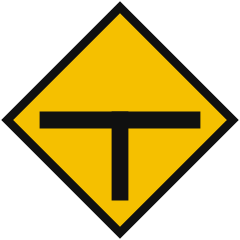
11. On which approach is this sign normally installed?
Show answer
Answer C: On the road that ends, far enough ahead for the driver to slow down
The warning belongs on the approach that terminates, placed early enough that the driver can lose speed and choose a direction before reaching the junction.
-
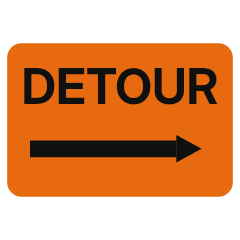
12. Once a driver has joined the route this sign begins, how is the rest of the way marked?
Show answer
Answer B: By further markers of the same kind at each turn, until the original road is rejoined
The alternate route is signed continuously, with a marker at every turn, so a driver with no local knowledge can follow it back to the original road.
-
13. You are stopped at a stop sign where your road ends at a two-way through street and you plan to turn left. What must you yield to?
Show answer
Answer B: Traffic from both directions and any pedestrians crossing
A left turn from the stem of a T crosses the near lane and joins the far one, so you give way to traffic in both directions and to pedestrians.
-
14. You find yourself in a lane that must turn, you wanted to go straight, and you cannot change lanes safely. What should you do?
Show answer
Answer D: Make the required turn and find another route
Going straight from a mandatory turn lane surprises everyone around you, while a wrong turn costs only a few extra minutes.
-
15. May you stop briefly across the sloped ramp that joins the sidewalk to the street at a corner?
Show answer
Answer B: No, that ramp must stay clear for people using wheelchairs
A curb ramp is the only way many people can get from the sidewalk to the crosswalk, so blocking it even briefly is prohibited.
-
16. You are traveling at 55 mph on a rural road and come up behind a horse-drawn buggy. What is the main danger?
Show answer
Answer D: You close on it very quickly because it moves at walking pace
A buggy travels only a few miles an hour, so the gap closes far faster than drivers expect and there is very little time to brake once you see it.
-
17. Is it acceptable to drive with your vehicle straddling the line between two lanes?
Show answer
Answer D: No, you must drive as nearly as practical entirely within a single lane
A vehicle astride the line takes up two lanes and leaves the drivers around it unable to predict where it will go.
-
18. How should a rider and passenger arrange to communicate during a ride?
Show answer
Answer A: By agreeing on simple signals or taps before the ride starts
Wind and engine noise make speech unreliable, so a short set of signals agreed in advance is the dependable way for a passenger to say they need to stop.
-
19. What does Wyoming statute require to prove reckless driving, as opposed to ordinary carelessness?
Show answer
Answer C: Willful or wanton disregard for the safety of persons or property
Wyoming statute defines reckless driving as operating a vehicle in willful or wanton disregard for the safety of persons or property, a higher standard than ordinary negligence.
-
20. On a long, straight highway you feel your attention fading. What helps you stay alert?
Show answer
Answer A: Keep your eyes moving, scan mirrors and signs, and take regular breaks
Staring at one point brings on highway hypnosis. Active scanning keeps the mind engaged, and a break every couple of hours restores alertness.
-
21. On a hot summer day you notice long black strips of crack sealant snaking across the pavement. What should a rider know about them?
Show answer
Answer A: They soften in heat and can be slippery, especially under a leaned tire
Crack sealant gets soft and greasy in the heat, so treat those strips as a low traction surface and avoid braking or hard cornering on them.
-
22. A grade crossing is marked only with a crossbuck and has no lights or gates. What does the crossbuck require of you?
Show answer
Answer C: Yield to rail traffic and cross only when no train is approaching
The crossbuck requires road users to yield the right-of-way to rail traffic, so you must look and listen and be ready to stop.
-
23. What counts as a complete stop at a stop sign?
Show answer
Answer C: The wheels stop turning before the stop line
A legal stop means the vehicle is no longer moving, made at the stop line or before entering the crosswalk or intersection.
-
24. How should riders in a staggered formation pass another vehicle?
Show answer
Answer D: One rider at a time
Passing one rider at a time keeps each pass short and prevents the group from occupying the other lane longer than necessary.
-
25. Well before an intersection, an overhead sign shows a diagram of the lanes with an arrow above each one. What is its purpose?
Show answer
Answer C: To let drivers pick the correct lane in good time
Advance intersection lane control signs display the lane assignment far enough back that drivers can move over calmly instead of at the last moment.