
Wyoming WYDOT Motorcycle Practice Test 50
- Questions25
- Correct to pass20
- Passing score80%
- Minimum age15 years
-
1. You are riding along a street lined with parked cars. What is the safest approach?
Show answer
Answer D: Move away from the parked cars, slow down, and watch for doors and people
Doors open, drivers pull out and pedestrians step between vehicles, so extra space and a lower speed give the rider time to see and react.
-
2. You are waiting to turn left across two oncoming lanes when a driver in the near lane stops and waves you through. What should you do?
Show answer
Answer D: Turn only after checking the far lane yourself
The waving driver cannot give away the right of way of the traffic in the second lane, which may not be stopping at all.
-
3. How does a NO OUTLET sign differ from a DEAD END sign?
Show answer
Answer B: It warns that a whole group of streets has no way out
No Outlet is posted where the road leads into a network of streets from which there is no through route, while Dead End refers to the single street itself.
-
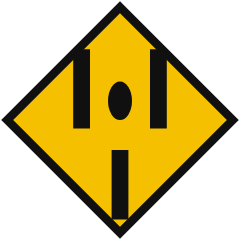
4. What must a driver be ready for beyond this sign?
Show answer
Answer C: Vehicles approaching from the opposite direction in the next lane over
The separation between the two directions runs out, so from that point oncoming vehicles share the same pavement and the driver has to keep right.
-
5. After a first Wyoming DWUI, what blood alcohol level at the time of arrest forces the driver onto an ignition interlock restricted license for six months?
Show answer
Answer D: 0.15 percent or greater
Wyoming requires a six-month ignition interlock restricted license after a first DWUI when the blood alcohol content at arrest was 0.15 percent or greater, before any other class of license can be issued.
-
6. Where must the engine cut-off switch be set before the starter button will crank the engine?
Show answer
Answer A: In the run position
The cut-off switch sits in the ignition circuit, so the engine will not start or run while it is set to off.
-
7. Is it acceptable to drive far below the flow of traffic on an open highway?
Show answer
Answer B: No, driving too slowly can obstruct traffic and create a hazard
Traffic that is much slower than the surrounding flow forces other drivers into sudden braking and unnecessary passing maneuvers, and impeding traffic is itself a violation.
-
8. A sign reads REDUCED SPEED LIMIT AHEAD. What does it tell you?
Show answer
Answer D: A lower limit begins further along the road
The sign gives advance notice so a driver can slow gradually, and the new figure takes effect at the speed limit sign that follows.
-
9. What is the correct way to think about protective gear?
Show answer
Answer D: It reduces injury in a crash but does nothing to prevent one
Gear is the last line of defense. Avoiding the crash depends on skill, speed choice, space and visibility, and gear only limits the damage when those fail.
-
10. Is it acceptable to leave your vehicle across the entrance of an alley for a short time?
Show answer
Answer A: No, the entrance must stay clear at all times
Blocking an alley entrance traps the vehicles inside and can keep emergency services out, so it is prohibited however brief the stop.
-
11. A line beside your lane is painted about twice the normal width. What does the extra width convey?
Show answer
Answer B: Greater emphasis on the restriction it carries
Width is part of the marking code: a wide line carries more emphasis than a normal one, which is why it is used at gores and channelizing lines.
-
12. A small signal face beside a bikeway shows red, yellow and green lenses that each carry a bicycle symbol. Whom does it control?
Show answer
Answer C: Bicyclists using that crossing or bikeway
A bicycle signal face governs bicycle movements only, and people on foot at the same corner still follow the pedestrian signal.
-
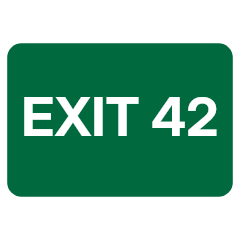
13. Where is signing of this kind normally placed along a freeway?
Show answer
Answer D: Ahead of the interchange and again at the exit, so a driver can reach the correct lane in time
Guide information for an interchange is repeated on the approach and at the ramp, because a driver who learns about the exit only at the last moment has no room left for a safe lane change.
-
14. You reach a four-way stop after another driver has already stopped there. What should you do?
Show answer
Answer D: Let the driver who stopped first proceed before you go
At a four-way stop the vehicles proceed in the order they arrived, so a driver who stopped before you goes first.
-
15. How does riding in a formation change your responsibility for your own space cushion?
Show answer
Answer C: It does not change it, because each rider still manages their own space and decisions
A formation organizes the group, but every rider remains responsible for their own following distance, escape paths and riding decisions.
-
16. At a rural intersection a beacon flashes yellow toward the main road and red toward the side road. How is each approach treated?
Show answer
Answer A: The main road slows and proceeds, the side road stops
An intersection control beacon assigns flashing yellow to the road with priority and flashing red to the approach that must stop and yield.
-
17. Which part of the body operates the gearshift lever?
Show answer
Answer B: The left foot
The gearshift lever sits ahead of the left footrest and is moved up or down with the left foot.
-
18. You are following another vehicle down a long, steep grade. What should you do about the gap?
Show answer
Answer D: Make it longer, because both of you need more room to stop
Everything takes longer to stop on a downgrade, including the vehicle ahead, so the gap that works on the flat is no longer enough.
-
19. Why is dusk one of the harder times of day to drive?
Show answer
Answer B: The failing light blurs shapes into the background
In fading light there is not enough contrast to pick objects out, yet it is not dark enough for headlights to do the work, so pedestrians and cyclists disappear.
-
20. You have just passed a large truck on the freeway. Why is it dangerous to pull back in front of it and then brake for your exit?
Show answer
Answer B: A loaded truck needs much more distance to stop than a car
A fully loaded tractor-trailer can need the length of a football field or more to stop from highway speed. Cutting in and braking leaves the driver no room to avoid hitting you.
-
21. A driver is tailgating you. Why is it a bad idea to tap or stab the brakes to warn them?
Show answer
Answer C: Because it cuts the little space they have and can cause a crash
Brake checking removes the small margin the tailgater has left and can provoke a collision; add space in front of you instead and let them pass.
-
22. An orange sign reading END ROAD WORK is posted beside the highway. What does it mark?
Show answer
Answer C: The point where the work zone restrictions stop
The sign is installed at the downstream end of the temporary traffic control zone to tell drivers that normal conditions apply again.
-
23. For a second Wyoming DWUI conviction, does the one-year ignition interlock requirement depend on the driver's measured blood alcohol content, the way the first offense does?
Show answer
Answer D: No, a second conviction always requires one year of interlock use, whatever the alcohol level was
Unlike a first offense, Wyoming statute imposes the one-year interlock requirement on every second DWUI conviction without regard to the measured alcohol concentration.
-
24. How often should you check your mirrors while driving?
Show answer
Answer C: Every few seconds, so you always know what is around you
Traffic behind and beside you changes constantly. Frequent, brief mirror checks keep a picture of your surroundings current so nothing surprises you.
-
25. A driver has to stop for a train at this sign. How far back from the nearest rail should the vehicle be held?

Show answer
Answer C: No closer than roughly fifteen feet
A train and its load overhang the rails, so stopping no closer than about fifteen feet keeps the vehicle outside the space the train actually sweeps.