
Wyoming WYDOT motorcycle warm-up test
- Questions25
- Correct to pass20
- Passing score80%
- Minimum age15 years
-
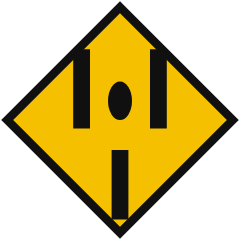
1. What must a driver be ready for beyond this sign?
Show answer
Answer C: Vehicles approaching from the opposite direction in the next lane over
The separation between the two directions runs out, so from that point oncoming vehicles share the same pavement and the driver has to keep right.
-
2. What should the operator do before a bump, a sharp turn or a sudden stop?
Show answer
Answer C: Warn the passenger so they can brace for it
A warning lets the passenger tighten their grip and prepare, which keeps the passenger weight from shifting unexpectedly at the worst moment.
-
3. What does the traffic law actually say about the right of way?
Show answer
Answer B: It says who must yield; no driver is ever entitled to take the right of way
The law describes who must yield. Right of way is something you give; insisting on it when another driver does not yield causes crashes.
-
4. Children are playing close to the edge of a residential street. What is the right speed choice?
Show answer
Answer D: Well below the limit, slow enough to stop for a sudden dash
Children can step out without warning, so the safe speed is the one that lets you stop within the distance you can see to be clear.
-
5. How do strong emotions affect driving?
Show answer
Answer B: They narrow your attention and make risky decisions more likely
Anger, worry and excitement all take attention away from the driving task and push drivers toward decisions they would not normally make.
-
6. Why should baggage be kept as low as possible on a motorcycle?
Show answer
Answer C: A high load raises the center of gravity and makes the machine unstable
Weight carried high changes the balance of the motorcycle and makes it feel top heavy in turns and in crosswinds.
-
7. Does using a hands free device remove the risk of distraction?
Show answer
Answer A: No, the conversation still takes attention away from driving
Hands free equipment removes the manual part of the distraction but not the mental part, and a driver deep in conversation can look straight at a hazard without registering it.
-
8. You are turning left across tracks that run along the center of the street. What should you do before crossing them?
Show answer
Answer B: Look along the tracks in both directions and cross only when clear
Rail vehicles running in the street can arrive from either direction and cannot stop quickly, so look along the tracks before you turn across them.
-
9. What does the T-CLOCS pre-ride inspection routine cover?
Show answer
Answer B: Tires and wheels, controls, lights, fluids, chassis and stands
T-CLOCS is a memory aid for a walk around check of tires and wheels, controls, lights and electrics, oil and other fluids, chassis, and side and center stands.
-
10. The car ahead drifts across the lane line and back again several times. What should you do?
Show answer
Answer C: Assume that the driver is distracted or impaired, and keep well back
Drifting is a classic sign of a distracted, drowsy or impaired driver, and distance is your protection from all three.