
Wyoming WYDOT Permit Practice Test 39
- Questions25
- Correct to pass20
- Passing score80%
- Minimum age15 years
-
1. Your left-turn lane faces a steady green ball and oncoming traffic is heavy. What are you allowed to do?
Show answer
Answer C: Move into the intersection and turn when a safe gap appears
A green ball permits the turn but gives no priority, so you may move into the intersection and wait there for a gap in the oncoming traffic.
-
2. On loose gravel or deep fresh snow, how does an antilock system affect the stopping distance?
Show answer
Answer D: It can lengthen it, although you keep the ability to steer
On loose surfaces a locked wheel piles up a wedge of gravel or snow that helps it stop, so the antilock stop can be longer even though steering still works.
-
3. You are driving in fog so thick that you can barely see the vehicle ahead. Which pavement marking is the best guide for staying in your lane?
Show answer
Answer A: The white edge line on the right side of the road
The right edge line keeps you positioned away from oncoming traffic and is easy to follow at low speed. Following tail lights closely tempts you to drive faster than you can see.
-
4. Besides an ignition interlock restriction, what alternative program may a Wyoming court order for a DWUI offender who would otherwise be restricted to interlock-equipped vehicles?
Show answer
Answer B: Participation in the 24/7 Sobriety Program
Wyoming statute allows a court to require participation in the 24/7 Sobriety Program Act as an alternative or addition to the ignition interlock requirement, with a restricted license available to those who comply.
-
5. You enter a work zone at night where one lane is closed and a flagger is on duty. What is the safest approach?
Show answer
Answer A: Slow early, merge before the closure and be ready to stop
Merging early at a reduced speed keeps the queue orderly and leaves you room to stop for equipment, workers or traffic that has halted ahead.
-
6. A pedestrian with a white cane draws the cane back and steps away from the curb as you approach. What does that usually mean?
Show answer
Answer B: They are signaling you to go ahead and drive on
Pulling the cane in and stepping back from the curb is the customary way a blind pedestrian tells drivers to proceed.
-
7. At what tread depth should a tire be replaced?
Show answer
Answer A: When the tread is worn down to 2/32 of an inch
At that depth a tire loses grip quickly, especially on wet roads, and the built in wear bars or the penny test both show when the point has been reached.
-
8. What does the license class code I indicate on a Wyoming driver license record?
Show answer
Answer C: An instruction permit rather than a full driving license
WYDOT's classification guide uses the class code I to mark a credential as an instruction permit rather than a full license.
-
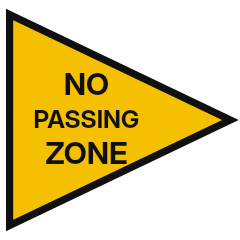
9. Where does the restriction that starts at this sign come to an end?
Show answer
Answer D: Where the centerline markings show that overtaking is allowed again
The sign marks the start of the restricted section, and the centerline markings along the road show how far it runs and where overtaking becomes lawful again.
-
10. Two solid white lines separate your lane from the lane beside it. What do they mean?
Show answer
Answer B: Crossing from one lane to the other is prohibited
A solid double white line marks a boundary that road users may not cross, such as the entrance to a preferential lane.
-
11. Your phone is in a mount on the dashboard rather than in your hand. What is true?
Show answer
Answer B: It still takes your eyes and mind off the road
A mount solves the hand problem but not the eye or the mind problem, and reading or tapping a mounted screen costs the same seconds of attention.
-
12. You are approaching a horse and rider on a country road. What about your horn?
Show answer
Answer C: Do not sound it at all, because the noise can frighten the animal
A startled horse is dangerous to its rider and to you, so pass wide and slow and leave the horn alone.
-
13. What ignition interlock period does Wyoming impose after a fourth or subsequent DWUI conviction?
Show answer
Answer A: Interlock use for the remainder of the offender's life, with review possible every five years
Wyoming statute requires lifetime interlock use after a fourth or subsequent DWUI conviction, though the offender may petition the court for removal every five years for good cause.
-
14. Why is a shoulder check especially important on a road with motorcycles and bicycles?
Show answer
Answer D: A narrow vehicle can disappear completely in the blind spot
A motorcycle or a bicycle is small enough to be hidden entirely by a door pillar or by the blind spot the mirrors do not cover.
-
15. How does Wyoming enforce a school bus stop-arm violation caught on the bus's video system when the driver's identity is unknown?
Show answer
Answer A: The registered owner of the vehicle is fined 195 dollars, subject to specific defenses
Wyoming statute lets a school district fine the registered owner of a vehicle 195 dollars based on a school bus video recording when the driver cannot be identified, subject to defenses such as lack of consent to the vehicle's use.
-
16. You are turning right on a red light where that is permitted. What does the law require first?
Show answer
Answer B: A full stop, then yielding to traffic and pedestrians
A right turn on red is allowed only after stopping completely and giving way to everyone who has the green, including people in the crosswalk.
-
17. Your light turns green, but a vehicle from the cross street is still finishing a turn inside the intersection. What should you do?
Show answer
Answer B: Wait until that vehicle has cleared the intersection
A green indication lets you proceed only after yielding to pedestrians in the crosswalk and to vehicles already lawfully within the intersection.
-
18. A pedestrian is crossing a wide four-lane street and has reached the lanes on the far side. When may you go on?
Show answer
Answer C: Only after the person has finished crossing the roadway
Waiting until the pedestrian has finished crossing is correct in every state and removes any doubt about how much clearance your state demands.
-
19. For a second Wyoming DWUI conviction, does the one-year ignition interlock requirement depend on the driver's measured blood alcohol content, the way the first offense does?
Show answer
Answer D: No, a second conviction always requires one year of interlock use, whatever the alcohol level was
Unlike a first offense, Wyoming statute imposes the one-year interlock requirement on every second DWUI conviction without regard to the measured alcohol concentration.
-
20. What should you expect while driving through a parking lot?
Show answer
Answer D: Pedestrians and vehicles moving from any direction, so drive slowly
Parking lots mix walking people, reversing vehicles and poor sight lines, so low speed and constant scanning are the only reliable protection.
-
21. A tractor-trailer is backing slowly across the roadway to enter a loading dock. What should you do?
Show answer
Answer C: Stop and wait until the truck has finished the maneuver
A backing truck driver has a very limited view and the trailer can swing unexpectedly. Trying to squeeze past in either direction risks being crushed.
-
22. The crossbuck, formed by two rectangular arms crossed in an X, is placed
Show answer
Answer D: on each highway approach to a railroad grade crossing
The crossbuck marks the location of a highway-rail grade crossing and is required on each highway approach to that crossing.
-
23. When may a Wyoming driver legally pass a school bus that is displaying flashing red lights?
Show answer
Answer C: Only when a physical barrier or separate roadways lie between the driver and the bus
Wyoming requires traffic in both directions to stop on an undivided road, but allows a driver to proceed with extreme caution when a physical barrier or separate roadways separate the vehicle from the bus.
-
24. A bicycle symbol topped by two chevrons is painted in the middle of a travel lane. What does that marking indicate?
Show answer
Answer D: Bicyclists share the lane with motor vehicles and may ride away from the curb
A shared lane marking shows drivers where bicyclists are likely to ride in a lane used by both bicycles and motor vehicles.
-
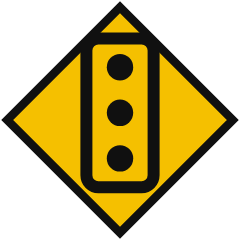
25. Why would this sign be installed on an approach?
Show answer
Answer B: Because the signal cannot be seen from far enough back for a driver to react in time
Advance notice of a signal is used where a crest, a curve, trees or a building keep the signal heads out of view until a driver is already too close to stop comfortably.