
Wyoming WYDOT Permit Practice Test 40
- Questions25
- Correct to pass20
- Passing score80%
- Minimum age15 years
-
1. You are in the right-hand lane of a multilane street and that lane becomes a right-turn-only lane ahead, but you want to go straight. What should you do?
Show answer
Answer B: Change into a through lane before you reach the markings for the turn lane
A lane-use arrow is a regulatory marking, so a driver who wants to continue straight has to leave that lane before it becomes a mandatory turn lane.
-
2. What does black ice usually look like from the driver seat?
Show answer
Answer C: A patch of pavement that simply looks wet or slightly glossy
Black ice is clear, so you see the dark road through it and read it as a wet patch. In freezing weather, treat any wet looking patch as ice.
-
3. You are turning left from a one-way street onto another one-way street. Which lane should you use?
Show answer
Answer B: Turn from the far left lane into the far left lane of the new street
The general turning rule is to turn from the lane nearest the direction of the turn into the nearest lane of the new roadway, which on a one-way to one-way left turn means far left to far left.
-
4. A line beside your lane is painted about twice the normal width. What does the extra width convey?
Show answer
Answer B: Greater emphasis on the restriction it carries
Width is part of the marking code: a wide line carries more emphasis than a normal one, which is why it is used at gores and channelizing lines.
-
5. In normal operation, which indication always comes between a green and a red on the same signal face?
Show answer
Answer C: A steady yellow
The yellow change interval must follow every green or green arrow, so a signal can never jump straight from green to red.
-
6. You are about to descend a long steep grade. How should you control your speed?
Show answer
Answer D: Select a lower gear before starting down and use the brakes in firm, brief applications
Engine braking in a lower gear carries most of the load down the grade, while continuous brake pressure overheats the brakes and reduces their effectiveness.
-
7. On dry pavement in good weather, what is the smallest following gap you should keep?
Show answer
Answer A: About three seconds behind the vehicle ahead
Three seconds is the accepted minimum on dry roads in good visibility, and the gap should be longer in poor conditions.
-
8. Is it acceptable to drive far below the flow of traffic on an open highway?
Show answer
Answer B: No, driving too slowly can obstruct traffic and create a hazard
Traffic that is much slower than the surrounding flow forces other drivers into sudden braking and unnecessary passing maneuvers, and impeding traffic is itself a violation.
-
9. On a long, straight highway you feel your attention fading. What helps you stay alert?
Show answer
Answer A: Keep your eyes moving, scan mirrors and signs, and take regular breaks
Staring at one point brings on highway hypnosis. Active scanning keeps the mind engaged, and a break every couple of hours restores alertness.
-
10. For a second Wyoming DWUI conviction within 10 years, what is the mandatory minimum jail term before the offender may be considered for probation or release?
Show answer
Answer B: 7 days
Wyoming statute requires at least 7 days in jail on a second DWUI conviction within 10 years, with no probation or early release available until that minimum is served.
-
11. What alcohol concentration triggers a Youthful Driver Suspension in Wyoming for a person under 21?
Show answer
Answer A: 0.02 percent or more
A Wyoming driver under 21 who is in actual physical control of a vehicle at 0.02 percent or more is suspended for DWUI, 90 days for a first offense and six months for a second within two years.
-
12. You are waiting to turn left and an oncoming vehicle stopped in the near lane to turn left blocks your view of the far lane. What should you do?
Show answer
Answer A: Wait where you are until you can see that the far lane is completely clear
The lane you cannot see is where the crash comes from, so you hold your position until the view opens up.
-
13. A small signal face beside a bikeway shows red, yellow and green lenses that each carry a bicycle symbol. Whom does it control?
Show answer
Answer C: Bicyclists using that crossing or bikeway
A bicycle signal face governs bicycle movements only, and people on foot at the same corner still follow the pedestrian signal.
-
14. You have just had bad news and you feel very upset. What should you do?
Show answer
Answer B: Wait until you have calmed down, or else let somebody else drive
Strong emotion takes attention away from the road as surely as alcohol or fatigue, so it is a reason not to drive yet.
-
15. Two solid yellow lines are painted down the center of a two-way road. What do they mean?
Show answer
Answer B: Traffic in neither direction may cross them to pass
A double solid yellow line marks a no-passing zone that applies to traffic traveling in either direction.
-
16. A blue motorist service sign showing a fuel symbol and an arrow means that
Show answer
Answer D: fuel is available in the direction shown, and the sign imposes no obligation
Service signs are informational: they tell the driver what is available and in which direction, but they create no requirement.
-
17. A regulatory sign posted at the start of a road reads LENGTH LIMIT 30 FEET. What does it control?
Show answer
Answer B: The overall length of vehicle allowed on that road
Some states post a length limit where tight curves or narrow structures lie ahead; it bars vehicles or combinations longer than the figure shown from using that road.
-
18. The green arrow protecting your turn changes to a steady yellow arrow. What is it telling you?
Show answer
Answer A: The protected turn is ending and you should prepare to stop
A steady yellow arrow warns that the arrow movement is being terminated and that a red indication will follow.
-
19. The route marker used for an Interstate highway is a shield with
Show answer
Answer A: white numerals on a blue field under a red band carrying the word INTERSTATE
The Interstate route marker is a cutout shield with a white border, the word INTERSTATE in white on red across the top and the route number in white on blue.
-
20. A vehicle in the lane beside you has stopped at a crosswalk. What should you do?
Show answer
Answer C: Stop as well, because that driver may be yielding to a pedestrian you cannot see
The stopped vehicle hides the crosswalk from you, and passing it is a leading cause of collisions with pedestrians who are already crossing.
-
21. Is it acceptable to drive with your vehicle straddling the line between two lanes?
Show answer
Answer D: No, you must drive as nearly as practical entirely within a single lane
A vehicle astride the line takes up two lanes and leaves the drivers around it unable to predict where it will go.
-
22. A traffic signal is dark and you reach the intersection at the same moment as a vehicle on your right. Who goes first?
Show answer
Answer A: The vehicle on your right, as at any all-way stop
A dark signal is treated as an all-way stop, and the usual tie-breaker then applies: the vehicle on the right goes first.
-
23. A driver passes this sign and the signal beyond it is already showing green. What is the safest response?
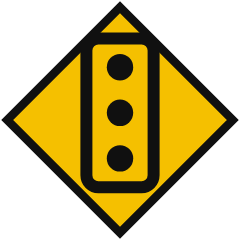
Show answer
Answer C: Ease off the accelerator and be ready to stop, because an indication that has been showing for a while is about to change
A signal that has been displaying the same indication for some time is close to changing, so arriving at a controlled speed with the brake covered is safer than accelerating to beat it.
-
24. A city transit bus ahead of you has stopped at the curb with its passenger door open. What does the law require of you?
Show answer
Answer D: Nothing special, but pass slowly and watch for people
The mandatory stop applies to a school bus showing red flashing lights, not to a transit bus, though a careful driver still slows for crossing passengers.
-
25. You are inside a tunnel with no shoulder when an ambulance comes up behind you with lights and siren. What should you do?
Show answer
Answer D: Keep going at a safe speed and pull over once you are clear of the tunnel
Stopping in a tunnel or on a narrow bridge blocks the only lane, so continue at a safe speed to the first place where you can pull clear.