
Wyoming WYDOT Permit Practice Test 3
Test 3 of 10. Pick an answer for each question to see if it is right and why; your score appears at the end. You need 20 correct answers to pass, the same ratio as the real Wyoming test.
- Questions25
- Correct to pass20
- Passing score80%
- Minimum age15 years
-
1. What is the maximum fine Wyoming allows for a third DWUI conviction within 10 years?
Show answer
Answer C: 3,000 dollars
Wyoming statute allows a fine of up to 3,000 dollars for a third DWUI conviction within 10 years, well above the ceiling for a first or second offense.
-
2. Under Wyoming law, is it a criminal offense to lend your driver's license to someone else so they can use it as their own?
Show answer
Answer A: Yes, it is a misdemeanor unlawful use of a license
Wyoming statute makes it a misdemeanor to lend a driver's license to another person or knowingly permit its use by someone else.
-
3. Why is it dangerous to make a left turn from the second lane from the center?
Show answer
Answer C: Because a driver in the lane beside you is turning into the same space
Drivers in the proper turn lane are entitled to that space, and turning across them puts two vehicles into one path through the intersection.
-
4. What is the maximum jail term and fine for a first Wyoming DWUI conviction, apart from any license suspension?
Show answer
Answer A: Up to 6 months in jail and a fine of up to 750 dollars
Wyoming statute punishes a first DWUI conviction as a misdemeanor with up to 6 months in jail, a fine of up to 750 dollars, or both.
-
5. Some crosswalks are marked with two transverse lines and others with a row of wide bars laid along the direction of travel. Why is the second pattern used?
Show answer
Answer B: It is far easier for an approaching driver to see
Longitudinal bar patterns are used where extra visibility is wanted, such as an uncontrolled crossing or one near a school, because they show up much better from a car.
-
6. Under Wyoming's texting ban, may a driver hold a phone to enter or select a number to place or receive a call?
Show answer
Answer D: Yes, entering or selecting a phone number or name to make or receive a call is a listed exception
Wyoming statute exempts writing, reading, selecting, or entering a telephone number or name for the purpose of making or receiving a call from the texting ban.
-
7. A blue motorist service sign showing a fuel symbol and an arrow means that
Show answer
Answer D: fuel is available in the direction shown, and the sign imposes no obligation
Service signs are informational: they tell the driver what is available and in which direction, but they create no requirement.
-
8. You enter a work zone at night where one lane is closed and a flagger is on duty. What is the safest approach?
Show answer
Answer A: Slow early, merge before the closure and be ready to stop
Merging early at a reduced speed keeps the queue orderly and leaves you room to stop for equipment, workers or traffic that has halted ahead.
-
9. What is the maximum fine for a first conviction of driving in a Wyoming high occupancy vehicle lane without qualifying to use it?
Show answer
Answer C: 50 dollars
Wyoming statute caps the fine for a first conviction of unlawfully using a high occupancy vehicle lane at 50 dollars, rising for repeat convictions within a year.
-
10. When may a Wyoming driver legally pass a school bus that is displaying flashing red lights?
Show answer
Answer C: Only when a physical barrier or separate roadways lie between the driver and the bus
Wyoming requires traffic in both directions to stop on an undivided road, but allows a driver to proceed with extreme caution when a physical barrier or separate roadways separate the vehicle from the bus.
-
11. Your vehicle has stalled on railroad tracks and no train is in sight. After getting everyone away, whom should you call first?
Show answer
Answer B: The railroad emergency number posted on the blue sign at the crossing, giving the crossing number
Every public crossing has a blue emergency notification sign with a phone number and a crossing identification number. That call lets the railroad stop or slow trains before they reach you.
-
12. Your light turns green while a pedestrian who started on the walk signal is still crossing in front of you. What must you do?
Show answer
Answer D: Let them finish crossing the road before you move off on your green light
A pedestrian who entered the crosswalk lawfully keeps the right of way until they reach the other side, whatever the signal now shows.
-
13. When is a child ready to use a vehicle seat belt without a booster seat?
Show answer
Answer A: When the lap belt lies across the upper thighs and the shoulder belt crosses the chest
Belt fit, not age, decides readiness. Until the child is tall enough for the lap belt to sit on the thighs and the shoulder belt on the chest, a booster is needed.
-
14. You are entering a freeway using an on-ramp with an acceleration lane. What is the correct technique?
Show answer
Answer C: Use the acceleration lane to reach the speed of traffic, then merge into a gap while yielding to traffic already on the freeway
The acceleration lane exists so you can match the speed of freeway traffic before merging, and drivers already on the freeway have the right-of-way.
-
15. On a rural two-lane road you pass small blue signs, each naming one business with an arrow and a distance. What are they?
Show answer
Answer D: Tourist-oriented directional signs for traveler businesses
Tourist-oriented directional signs carry a white legend on blue and are used on rural conventional roads to guide travelers to eligible businesses.
-
16. How does Wyoming's careless driving statute differ from its reckless driving statute?
Show answer
Answer D: Careless driving is judged by ordinary negligence creating unreasonable risk, while reckless driving requires willful or wanton disregard
Wyoming statute defines careless driving as operation inconsistent with the care a reasonably prudent person would exercise, a lower standard than the willful or wanton disregard required for reckless driving.
-
17. How does alcohol change the time a driver needs to respond to a hazard?
Show answer
Answer A: It slows it, so stopping takes longer
Alcohol is a depressant that lengthens the time between seeing a hazard and acting on it, which adds directly to the distance needed to stop.
-
18. How should the inside rearview mirror be adjusted?
Show answer
Answer B: So you can see the entire rear window without moving your head
The inside mirror is for the view straight behind you. Framing the whole rear window from your normal seating position gives the widest useful view.
-
19. A yellow sign reads SOFT SHOULDER. What is it telling you?
Show answer
Answer C: The shoulder may not carry the weight of a vehicle
A soft shoulder is unpaved and can let a wheel sink, so a driver who leaves the pavement there may lose control or become stuck.
-
20. Away from a school or construction zone, how many miles per hour over the posted limit must a Wyoming driver exceed before the violation is recorded on the driving record?
Show answer
Answer B: At least 6 miles per hour over the posted limit
Wyoming statute keeps a speeding conviction of less than 6 miles per hour over the posted limit off the driving record in ordinary zones, apart from school and construction zones.
-
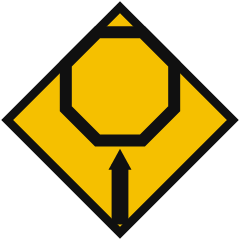
21. On a wet road, how should a driver adjust after passing this sign?
Show answer
Answer B: Start braking earlier, because a slippery surface lengthens the stopping distance
A wet surface lengthens stopping distance, so the extra warning distance should be spent braking gently and early instead of late and hard.
-
22. Does a fine issued to a vehicle's registered owner for a school bus stop-arm camera violation count as a moving violation for license suspension purposes?
Show answer
Answer B: No, it is not considered a moving violation or a prior conviction for any other purpose
Wyoming statute specifically states that a fine issued to a registered owner under the school bus camera provision is not considered a moving violation for license suspension purposes, nor a prior conviction for any other purpose.
-
23. Heavy trucks have worn deep ruts into a highway lane and rain has filled them. What is the danger?
Show answer
Answer D: Water collects in them, so the tires can lose contact with the road
Ruts hold standing water long after the rest of the lane has drained, which makes them the most likely place to start hydroplaning.
-
24. When Wyoming mandatorily suspends or revokes a driver's license, what also happens to every vehicle registered in that person's name?
Show answer
Answer A: The registrations are also suspended, unless the person gives and maintains proof of financial responsibility
Wyoming statute suspends the registration of every vehicle registered in a person's name whenever that person's license is mandatorily suspended or revoked, unless proof of financial responsibility is given and maintained.
-
25. If a Wyoming driver cannot show proof of insurance during a traffic stop, how long does the law give the driver to produce that proof afterward?
Show answer
Answer A: 7 days
Wyoming statute gives a driver who cannot show proof of insurance during a stop 7 days to produce that proof before facing conviction.